4.1 Quick revision
A study of obstructive sleep apnoea (OSA) in adults with Down Syndrome (de Carvalho et al. 2020) had \(n = 60\) adults (\(27\) females; \(33\) males) undergo a sleep study. The data are shown in Fig. 4.2. (REI is the Respiratory Event Index; an REI under \(5\) refers to no sleep apnoea; an REI of \(30\) or over refers to severe sleep apnoea.)
- Which of these would be an inappropriate numerical summary for the age of the participants?
- Median.
- Odds.
- Standard deviation.
- Mean.
- What might be an appropriate way to numerically describe the amount of variation in the ages of participants?
- Standard deviation.
- Median.
- Mean.
- Odds.
- What might be an appropriate way to numerically describe the average Respiratory Event Index (REI) of participants?
- Percentage.
- Odds.
- Standard deviation.
- Mean.
- What might be an appropriate way to numerically describe the gender of the participants?
- Standard deviation.
- Median.
- IQR.
- Percentages.
- In the sample of \(n = 60\), what percentage of individuals are females?
- 0.82.
- 0.45.
- 45%.
- 55%.
- 0.55.
- In the sample of \(n = 60\), what are the odds that an individual is female?
- 0.45.
- 45%.
- 55%.
- 0.55.
- 0.82.
- Use the jamovi output in Fig. 4.1 to find the mean of Gender, and explain what this means.
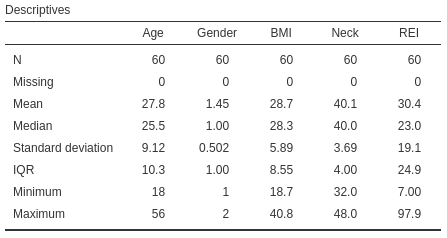
FIGURE 4.1: A numerical summary of the OSA data: jamovi
FIGURE 4.2: The Obstructive Sleep Apnoea (OSA) data set
References
de Carvalho AA, Amorim FF, Santana LA, de Almeida KJQ, Santana ANC, Neves F de AR. STOP-Bang questionnaire should be used in all adults with Down Syndrome to screen for moderate to severe obstructive sleep apnea. PloS ONE. 2020;15(5):e0232596.